Stop Selling and Start Serving
Mega Camp 2026 · Corey Perlman
Corey Perlman runs a digital agency and has spent fifteen years doing this for clients like Delta and the Dallas Cowboys. He opened by promising the room he would not ask them to dance on TikTok, post seventeen times a day, or become the Kardashian of real estate. What he offered instead was to make the things you already do work better.
Stop selling. Start serving.
His opening slide, and the question that came with itHis first question was whether, if he pulled up your Instagram on the big screen right now, the room would see you serving your audience or selling to them. He then offered to grade a few profiles live, let the panic sit for a second, and admitted he was kidding.
Pick a few platforms instead of all of them. Use the features each one is actually pushing. Talk to one specific person instead of everybody. Build a series rather than one off posts. Show what you do in your community. And spend more time in other people’s comments than on your own posts.
The parrot and the owl
A decade ago Corey used this on stage and forgot about it. A few months ago a man ran up to him and said he still tries not to be that squawking parrot. Corey had no idea what he was talking about, then remembered, and decided it had earned its place back in the talk.
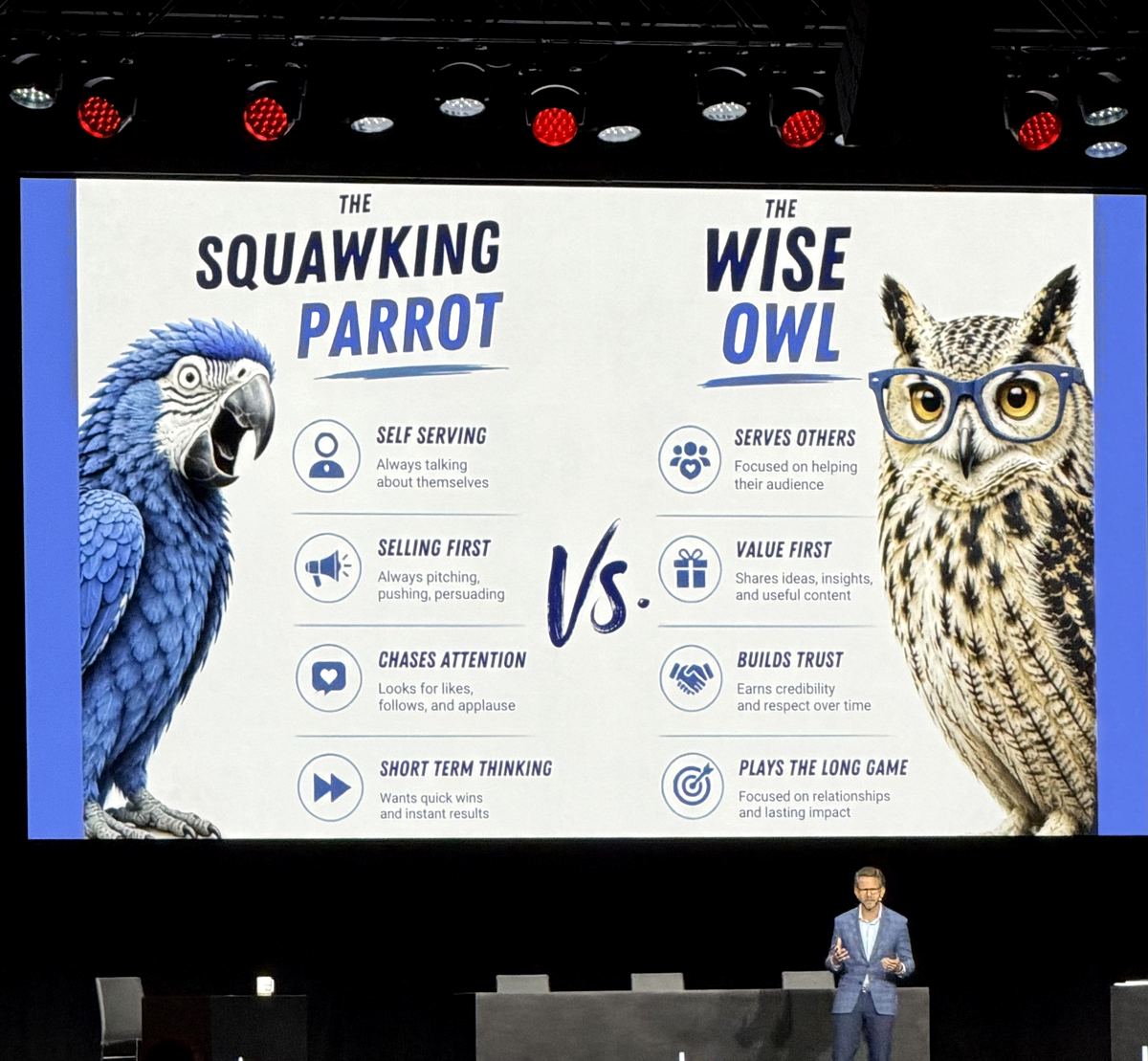
| The squawking parrot | The wise owl |
|---|---|
| Self serving. Always talking about themselves | Serves others. Focused on helping their audience |
| Selling first. Always pitching, pushing, persuading | Value first. Shares ideas, insights and useful content |
| Chases attention. Looks for likes, follows and applause | Builds trust. Earns credibility and respect over time |
| Short term thinking. Wants quick wins and instant results | Plays the long game. Focused on relationships and lasting impact |
He brought a bag of small toy owls with him and offered one to anyone who found him later and committed to being the owl.
One. Do not be a jack of all sites and a master of none
He gave the room permission most social media speakers will not.
You don’t have to be on TikTok. Thank you everybody, good night.
Corey Perlman
His shortlist is an acronym he admits does not sit in priority order because it would not spell the word. LIFT. LinkedIn, Instagram, Facebook, TikTok.
- Instagram and Facebook are one and two. Your market is there and that should surprise nobody.
- LinkedIn is badly underused in this industry, which is where most of his upside argument sits.
- TikTok has an audience but a young one. His question for it: are you trying to build a brand or sell something?
Two. Go deep, not wide
Having let you off the hook for platforms, he tightens on features. Use everything a platform gives you, especially whatever it is currently promoting.
The algorithms favor the bold. They will reward you for using the features that are most emphasized.
Corey Perlman
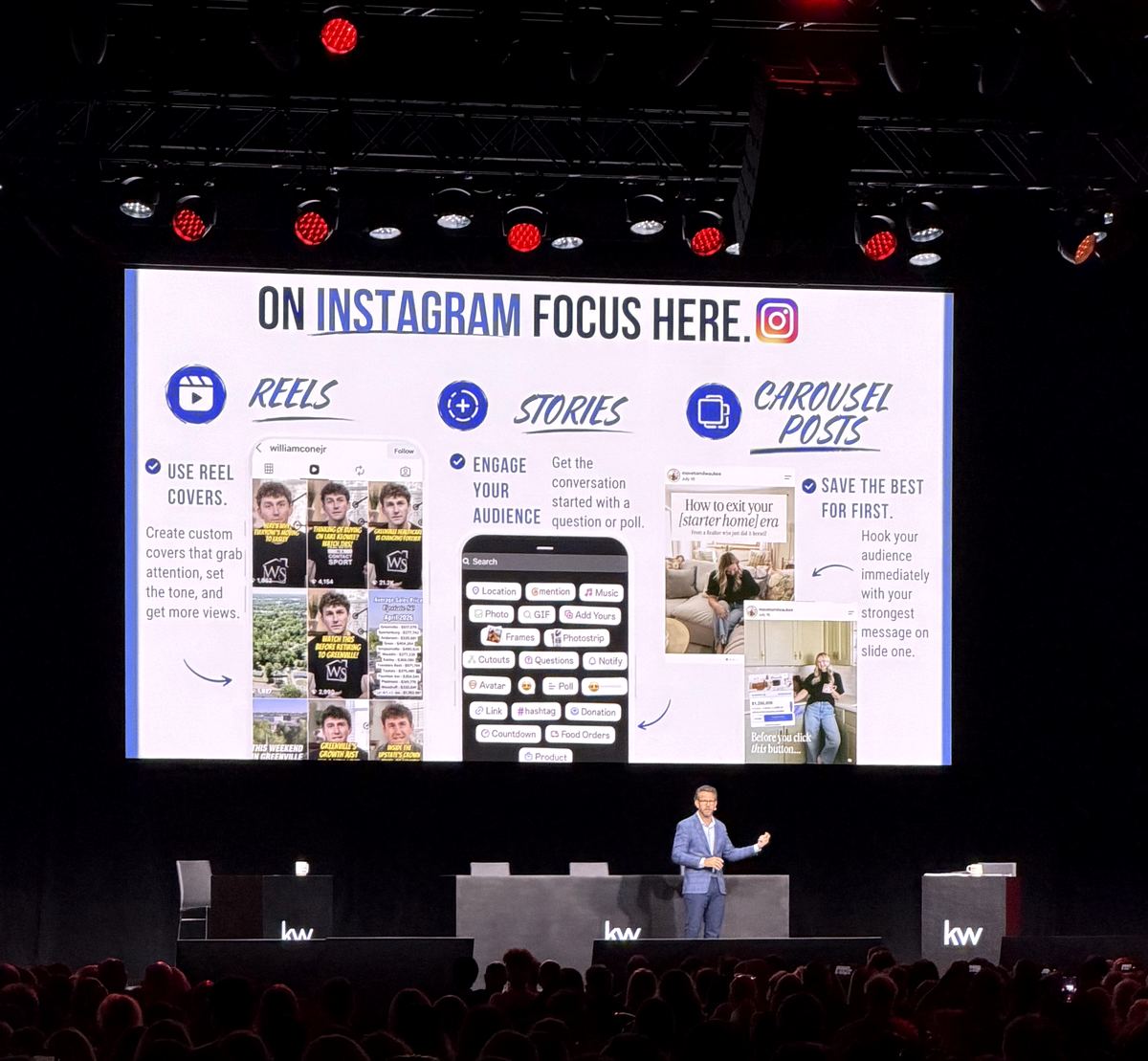
Reels: put covers on them
This was the single most common gap he found looking through agent profiles. A reel with no cover gives someone nothing to decide on.
You need to tell somebody why they should watch your video, with writing, before they ever see the play button.
Corey Perlman
His shortcut if you are stuck: ask an AI tool for a reel cover for the video, tell it you want it compelling, tell it you want it to stop the scroll.
Stories: an audience that never sees your feed
He asked how many people go to Instagram and look at stories rather than the feed. A couple hundred hands went up. If you are not posting stories, those people do not see you at all. He recommends opening with something that invites a reply, a poll or a question.
Carousels: save the best for first
Credited to Rory Vaden. Do not build to a reveal. Put the payoff on slide one and then deliver it.
This is the one tip you need to know before buying a home. Then give it to them. Start with the end in mind.
Corey Perlman
The one thing he actually asked people to add
He was explicit that this is the only new task in the whole talk. Start a LinkedIn newsletter. LinkedIn is pushing the format hard, almost nobody in the room was using it, and it lands in inboxes by email.
His version of doing it without extra work: take the email piece you already send, hand it to AI, ask it to reformat for LinkedIn’s newsletter format, publish once a month.
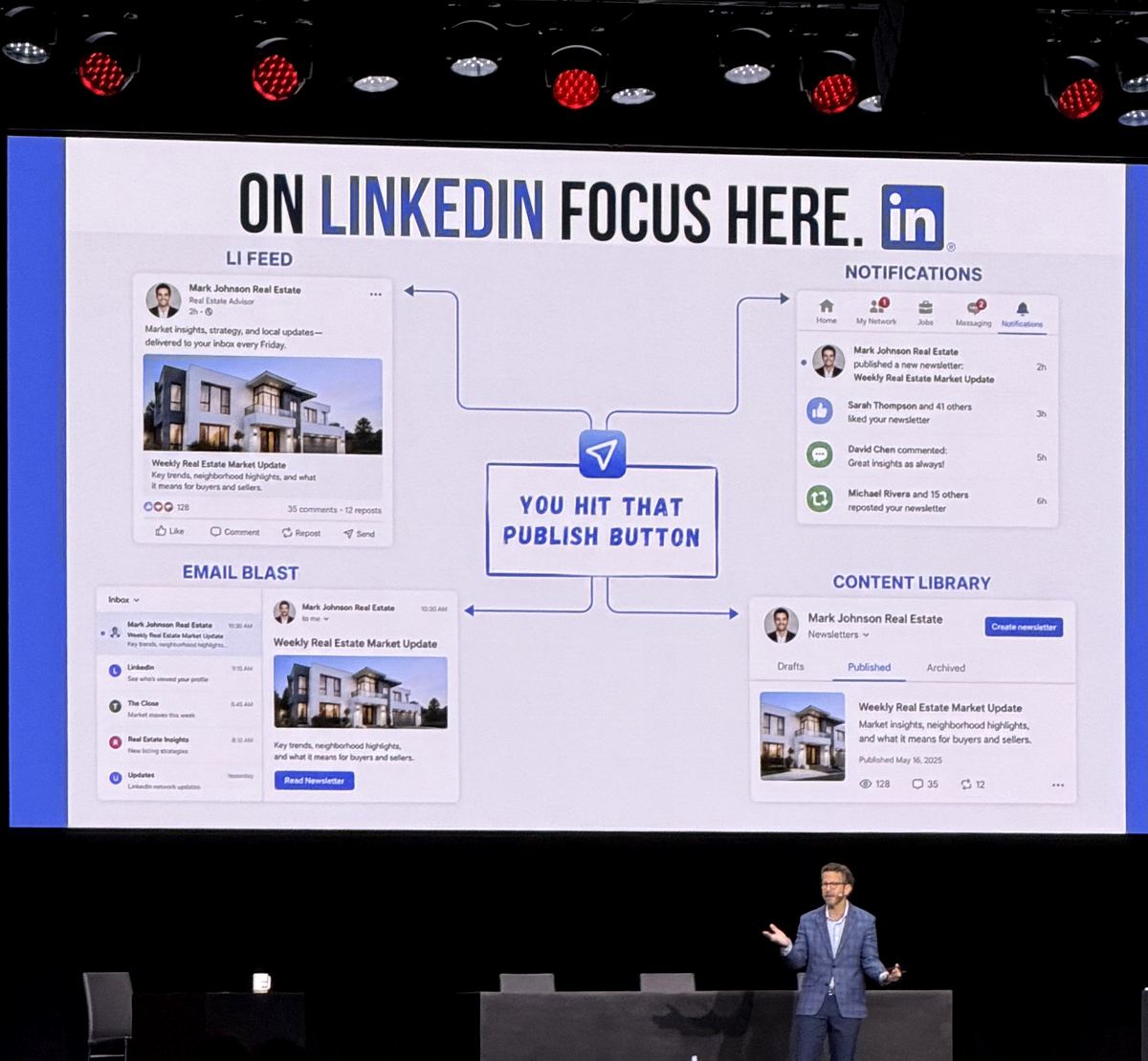
The slide is the actual argument for it. You hit publish once and it goes four ways at the same time.
| Where it lands | What that gets you |
|---|---|
| Your LinkedIn feed | The normal post everyone sees |
| Notifications | Subscribers get told a new issue is out |
| It arrives in the inbox, which is the part nobody expects | |
| A content library | Every back issue stays published and findable |
Put it out once a month and then come see me in a year.
Corey Perlman
Three. Know who you are talking to
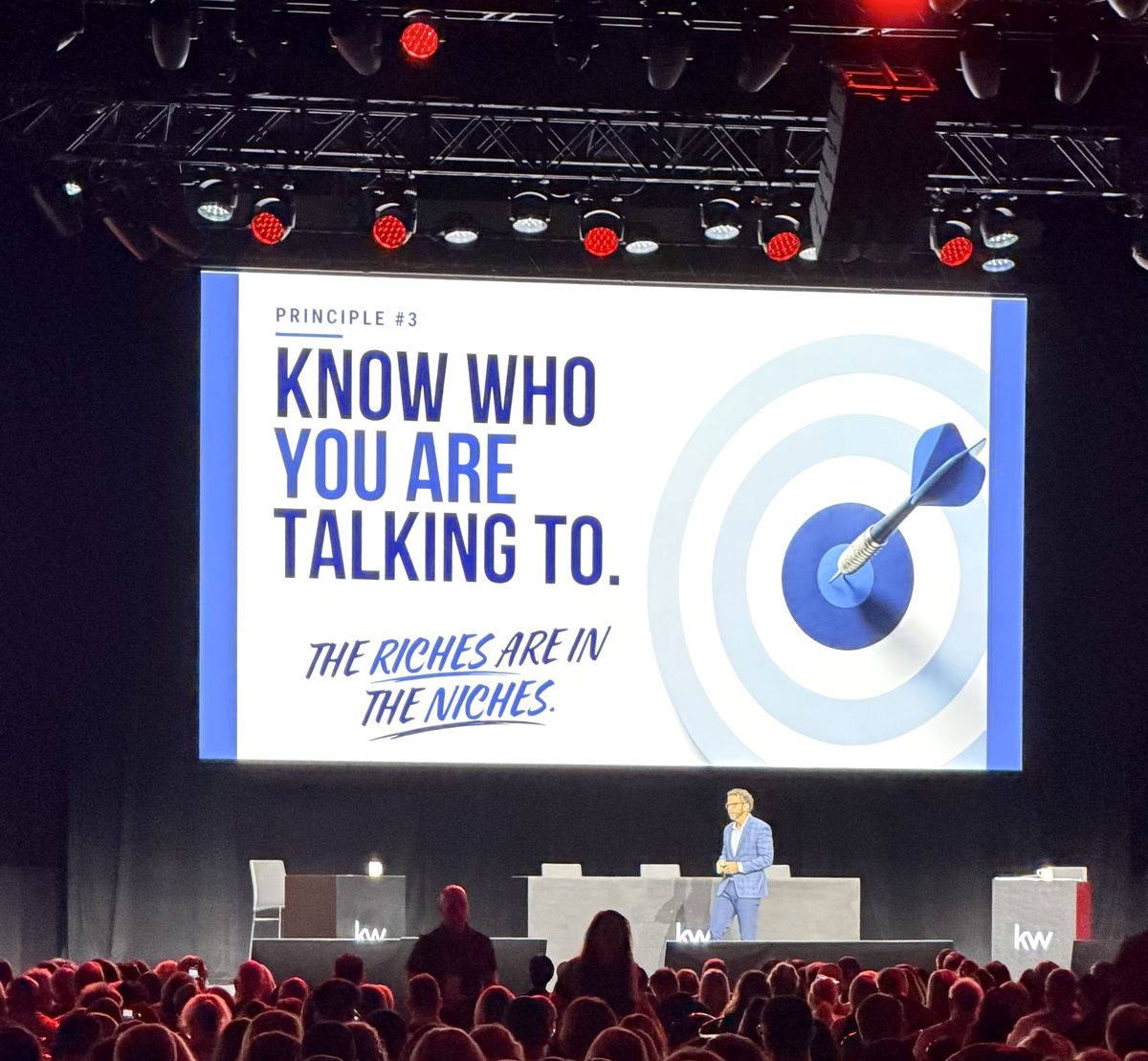
When we talk to everybody, we talk to nobody.
Corey Perlman
He nodded at Gary’s book here, on narrowing focus down to one thing, and said his version is narrowing the audience.
If you’re not getting enough engagement, if you’re not getting enough DMs, if you’re not getting enough phone calls from social, it’s because we don’t hear you. It’s because you’re not talking to us.
Corey Perlman
This is where he stopped talking and made the room prove it to itself. It was the best five minutes of the session and it does not read on a slide, so it is worth walking through properly.
He asked everyone who was able to stand up
Then to stay standing if they work in real estate. Nearly four thousand people stayed on their feet.
I want you to think of this as a metaphor for the world of social. You are competing with everybody in the room right now, if you are posting something just about real estate.
Corey Perlman
Then he asked everyone to picture one recent client, and started cutting.
| Stay standing if your client is | What happened |
|---|---|
| Selling, not buying | A few sat down |
| A seller with a growing family | More sat down |
| Selling because they have outgrown the house | More sat down |
| Buying at the same time, staying in the same school district | More sat down |
| Both partners working from home | About 25 people left standing |
Look around the room. We have now niched down to a demographic where you are competing with a lot less noise. Less noise, more relevance. The riches are in the niches.
Corey Perlman
The point that lands is that nobody had to change anything about their business to get there. Same agents, same clients, five sentences of specificity, and the competition went from everybody to almost nobody.
The prompt he gave for finding yours
He put a prompt on screen and told the room to photograph it. The important part is the second sentence.
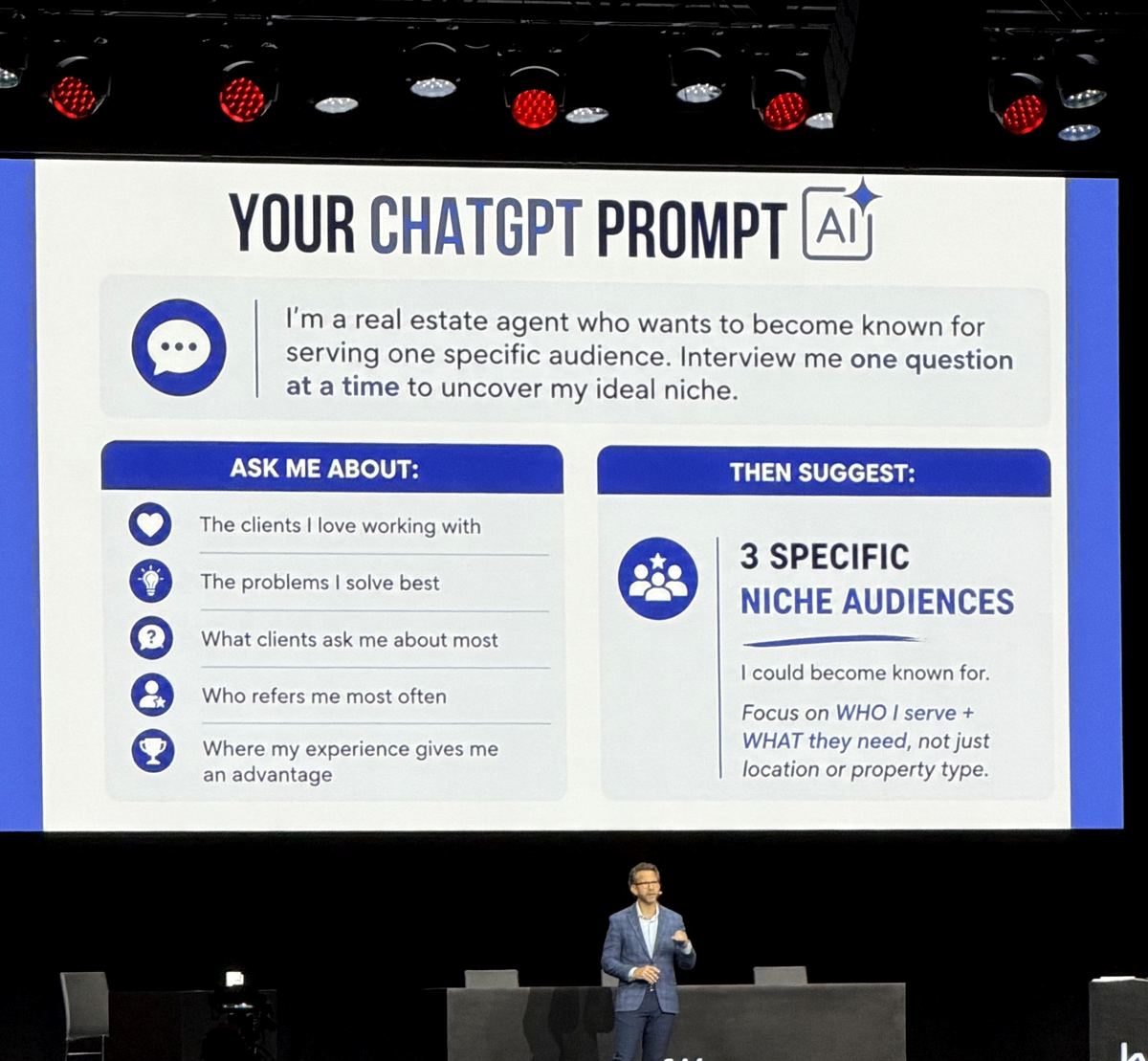
I’m a real estate agent who wants to become known for serving one specific audience. Interview me one question at a time to uncover my ideal niche.
Corey Perlman’s prompt
The slide then tells it what to ask you about. The clients you love working with, the problems you solve best, what clients ask you about most, who refers you most often, and where your experience gives you an advantage. Then it asks for three specific niche audiences you could become known for.
And it ends with the constraint that does the real work.
Focus on who I serve and what they need, not just location or property type.
From the slide
If you have not asked your AI tool of choice to interview you first, it cannot help you with your social media content moving forward.
Corey Perlman
Four. Be the show, not the commercial
Stop making one off posts and start making a series. The format matters less than the two rules, which are be consistent and let the episodes build on each other. He put six worked examples on screen.
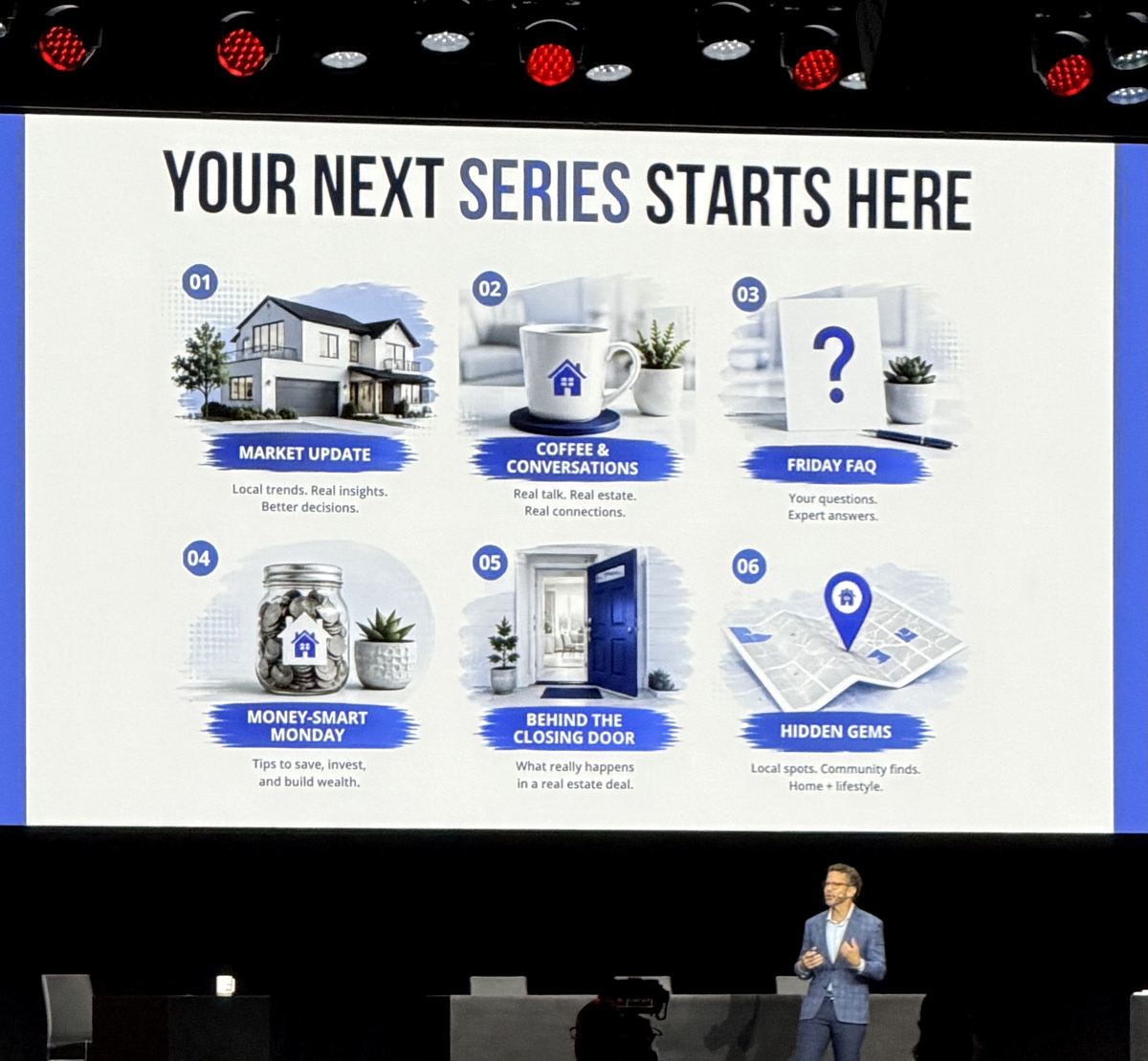
| Series | The pitch |
|---|---|
| Market Update | Local trends. Real insights. Better decisions. |
| Coffee & Conversations | Real talk. Real estate. Real connections. |
| Friday FAQ | Your questions. Expert answers. |
| Money-Smart Monday | Tips to save, invest and build wealth. |
| Behind the Closing Door | What really happens in a real estate deal. |
| Hidden Gems | Local spots. Community finds. Home and lifestyle. |
Think about how you scroll social right now. The ones you stick with are episodes, aren’t they?
Corey Perlman
Why he thinks this is about to matter more
He gave the room a heads up that Instagram is building a playlist feature, closer to how Netflix groups episodes. Right now, if you see someone’s pickleball video and want another, you have to go dig through their feed. Playlists would make a series clickable as a set.
If you start these series now, you’ll thank me later when you see where Instagram is headed.
Corey Perlman
The four part structure for each episode
- A hook that stops people
- A quick introduction
- The actual value
- A call to action, which is the one everyone skips
His note on the call to action is the useful part. It should not be “call me to sell your home,” because the person watching is nowhere near that stage.
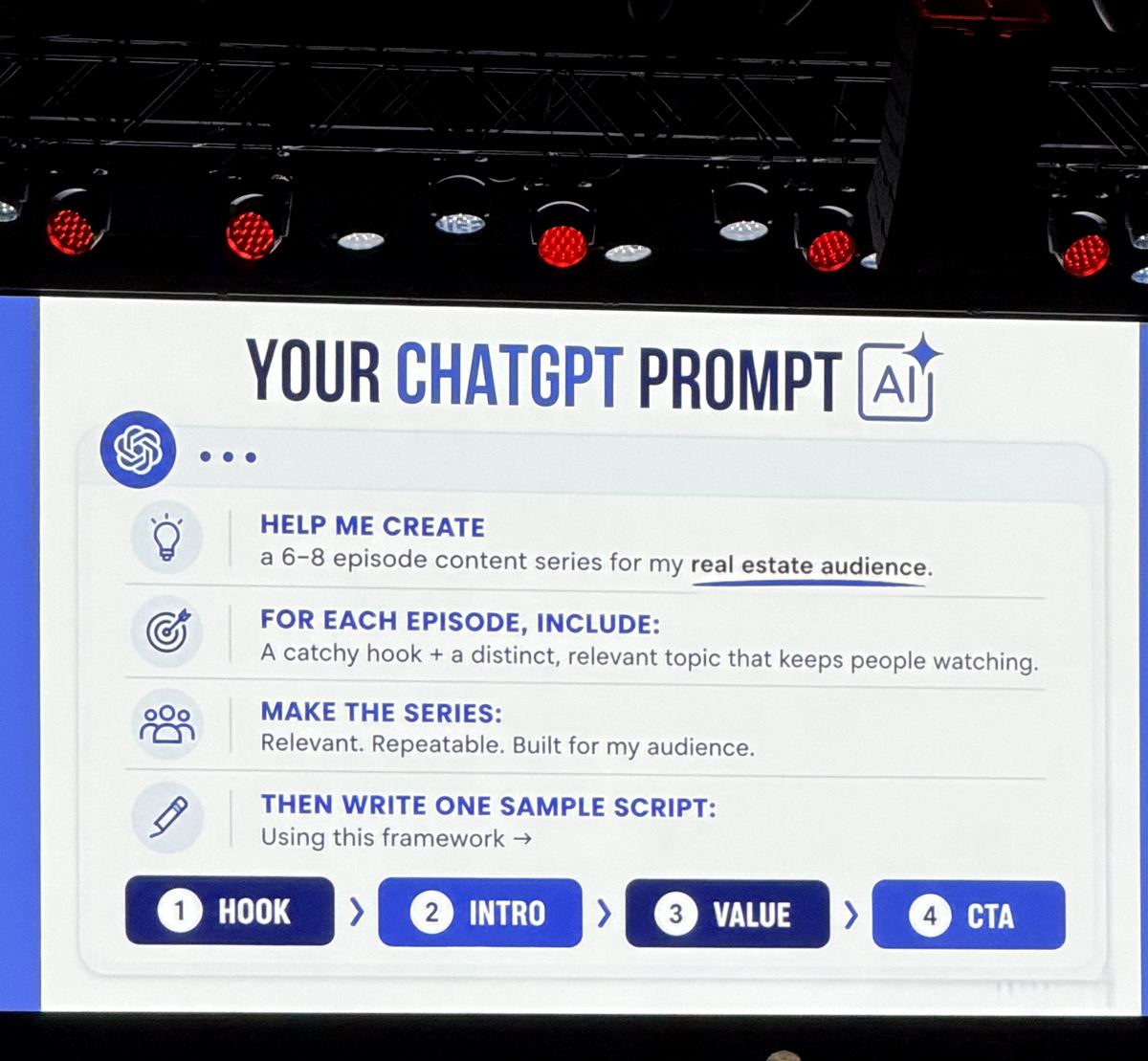
The second prompt asks for a six to eight episode series for your audience, a catchy hook and a distinct topic for each one, the whole thing relevant, repeatable and built for that audience, then one sample script written to the hook, intro, value, call to action structure.
Tell them the easy next step. Like the page. DM me. Send this to a friend. And make that consistent too.
Corey Perlman
Five. Doing good is good for business
He had researched the room and noticed how much community work happens without ever being shown. His argument is that people already choose agents partly on culture and values, so leaving it off your feed is throwing away something you have already earned.
He also flagged a second use for it that has nothing to do with clients. For anyone running an office, showing what you support is one of the better ways to attract agents who want to work somewhere with the same values.
And it does not have to be charity. His friend Bill is an agent in his community, and Bill’s best performing post of the year was a tour of the local Christmas lights.
Six. Be down with other people’s posts
He borrowed the nineties reference and repurposed it. Not other people’s property. Other people’s posts.
Instead of thinking about what to post on social, I want you to think about who to communicate with on social.
Corey Perlman
Then he made it personal. He asked how many people read the comments on their own posts. Most hands. How many smile when they see them. Most hands again.
It feels good. Imagine if you did that for the people who refer you business. Imagine if you did that for your favourite client.
Corey Perlman
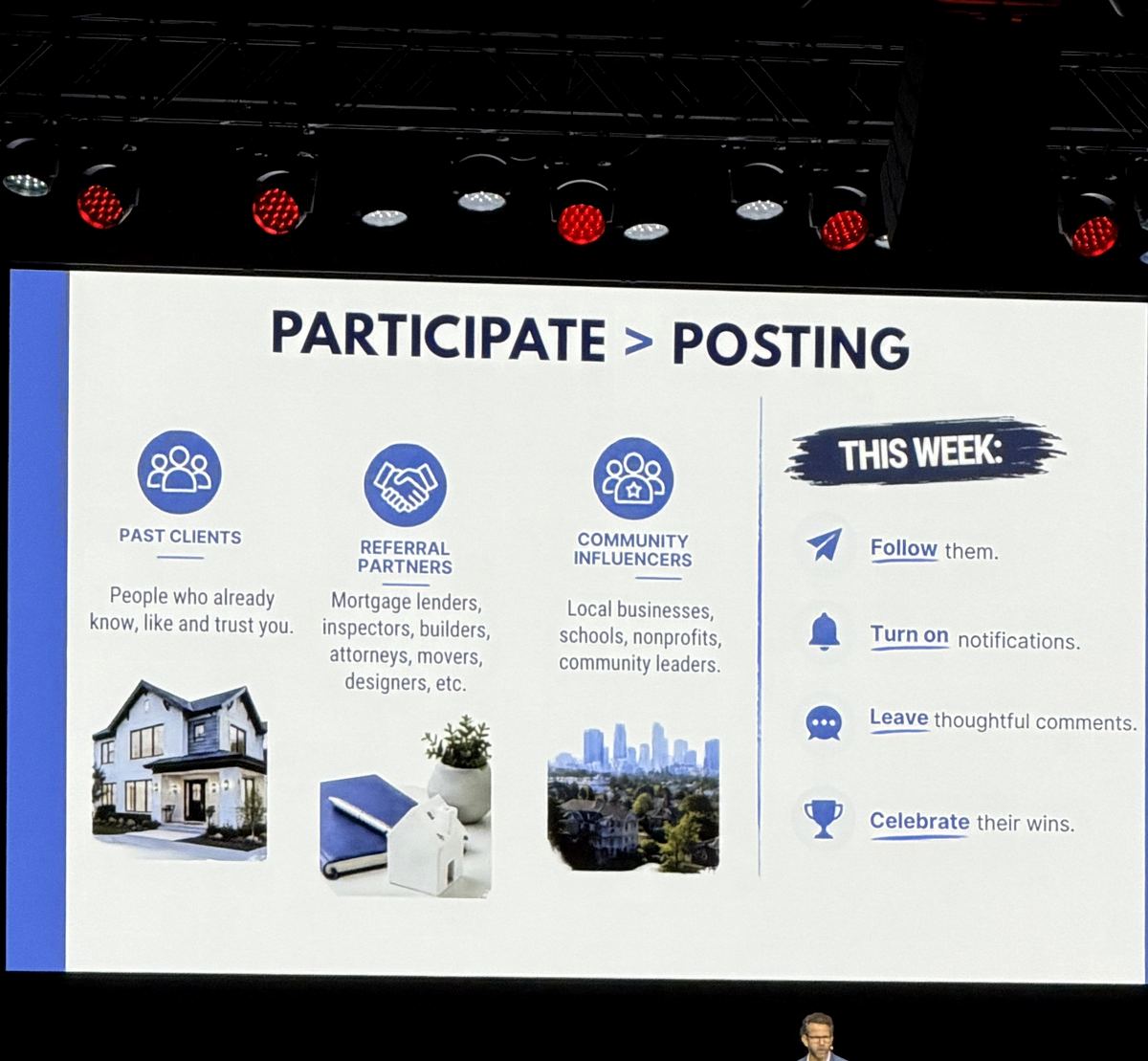
The slide put a cleaner headline on it than the joke did. Participate is greater than posting. Three groups, and four things to do this week.
| Who | Why them |
|---|---|
| Past clients | People who already know, like and trust you |
| Referral partners | Mortgage lenders, inspectors, builders, attorneys, movers, designers |
| Community influencers | Local businesses, schools, nonprofits, community leaders |
Follow them. Turn on notifications. Leave thoughtful comments. Celebrate their wins.
Turning notifications on is the one that makes the other three happen. Without it this is a good intention competing with your own feed, and the feed wins.
The standing exercise is the whole talk. Everything else is tactics. That one demonstration shows you, physically, that specificity is the only thing that removes competition, and it costs nothing to apply.
Reel covers are the cheapest fix on the list. He looked at a lot of agent profiles and this was the most common miss. It is one line of text on something you already made.
Have the AI interview you before you ask it for anything. That reframe is worth more than the prompt itself, and it applies well beyond social.
Fix your call to action. If every post ends with a version of “call me to list your home,” you are asking people at the top of the funnel to behave like they are at the bottom.
And the one he actually asked for. Start the LinkedIn newsletter. It is monthly, it reuses an email you already write, and almost nobody in a room of four thousand had one.
More from Mega Camp 2026
- Gary Keller’s market update, chart by chart
- Gary Keller on the four engines of wealth
- Gary Keller interviews Simon Sinek
- Amy Porterfield on social media feeding your database
- Corey Perlman on stopping the sell and starting to serveyou are here
Jason Flynn. I run a real estate office in Santa Cruz and write about AI, marketing and the operating side of the business. I go to a lot of these and write up the parts that were worth the trip.
Written from a recording of Corey Perlman’s session at Mega Camp 2026. The auto transcript never identified him by name and labelled him as an unnamed speaker throughout, so every quote here is attributed by me from context. Treat them as close paraphrase rather than verbatim. I have cut the event housekeeping at the top and the group video he filmed at the end, neither of which reads on a page.
Like this? Get the next one.
The AI plays I'm running, a couple times a month. Free.