Gary Keller on Wealth
Mega Camp 2026 · Gary Keller on wealth
Gary teaches this to kids by asking one of them to hand over a shoe. Then he offers to buy it. A dollar, sure. Ten, sure. Thirty, forty, still yes. Two hundred and the room says no way. He does the same with a coffee mug at five cents, then at thirty dollars, and gets the same answer.
The only difference between you and financially wealthy people is you’ve mastered the valuation of bullshit.
Gary Keller, about four minutes in
You already know exactly what a shoe is worth, because you have spent your life valuing things that lose value the moment you buy them. Wealthy people are fluent in the other kind of valuation, assets that appreciate or produce income, and they cannot tell you what the shoe costs because they do not care. Everything else in the session is a framework for getting fluent in the second language.
Built from the recording plus my own notes. The recorder struggled again and mangled at least one line badly enough that the notes had to fix it, which I flag where it happens. Gary opened by saying the whole thing is his own view, and I have kept that framing.
You are already an expert appraiser
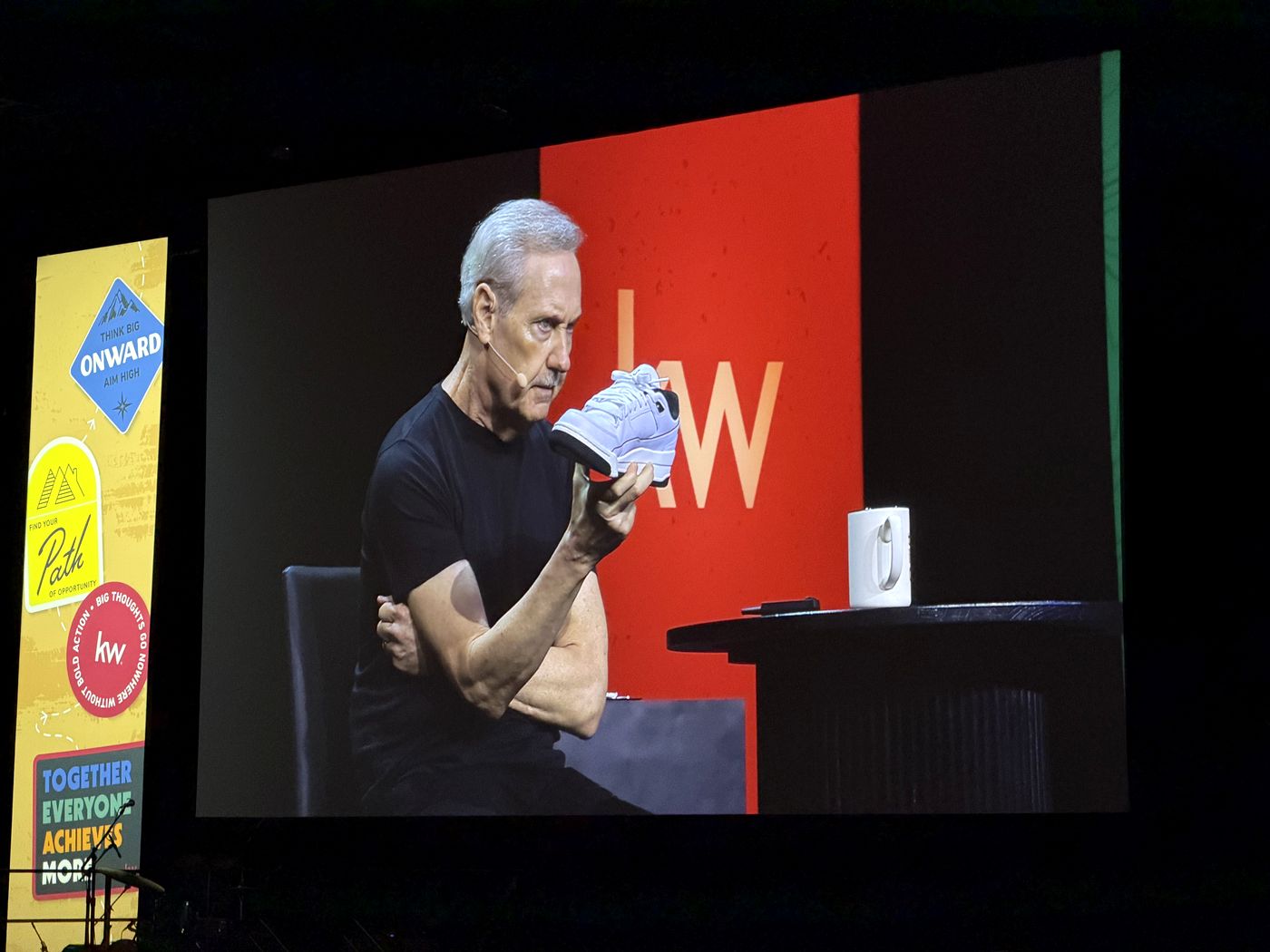
The point of the shoe game is that nobody hesitates. Everyone knows the shoe is not worth two hundred dollars and the mug is not worth thirty. You have priced food, clothing, movie tickets and phones your whole life. You are good at it.
You’ve mastered the valuation of things that go down in value the second that you buy them, and they generate no income. And you’re a master at it.
Gary Keller
Then the turn. People who are financially wealthy are fluent in the other valuation, the one for things that appreciate or throw off income. And they genuinely could not tell you what the shoe is worth, because it never mattered to them.
My goal is to make you financially literate as fast as possible.
Gary Keller
You will never have enough if you do not know why you need it
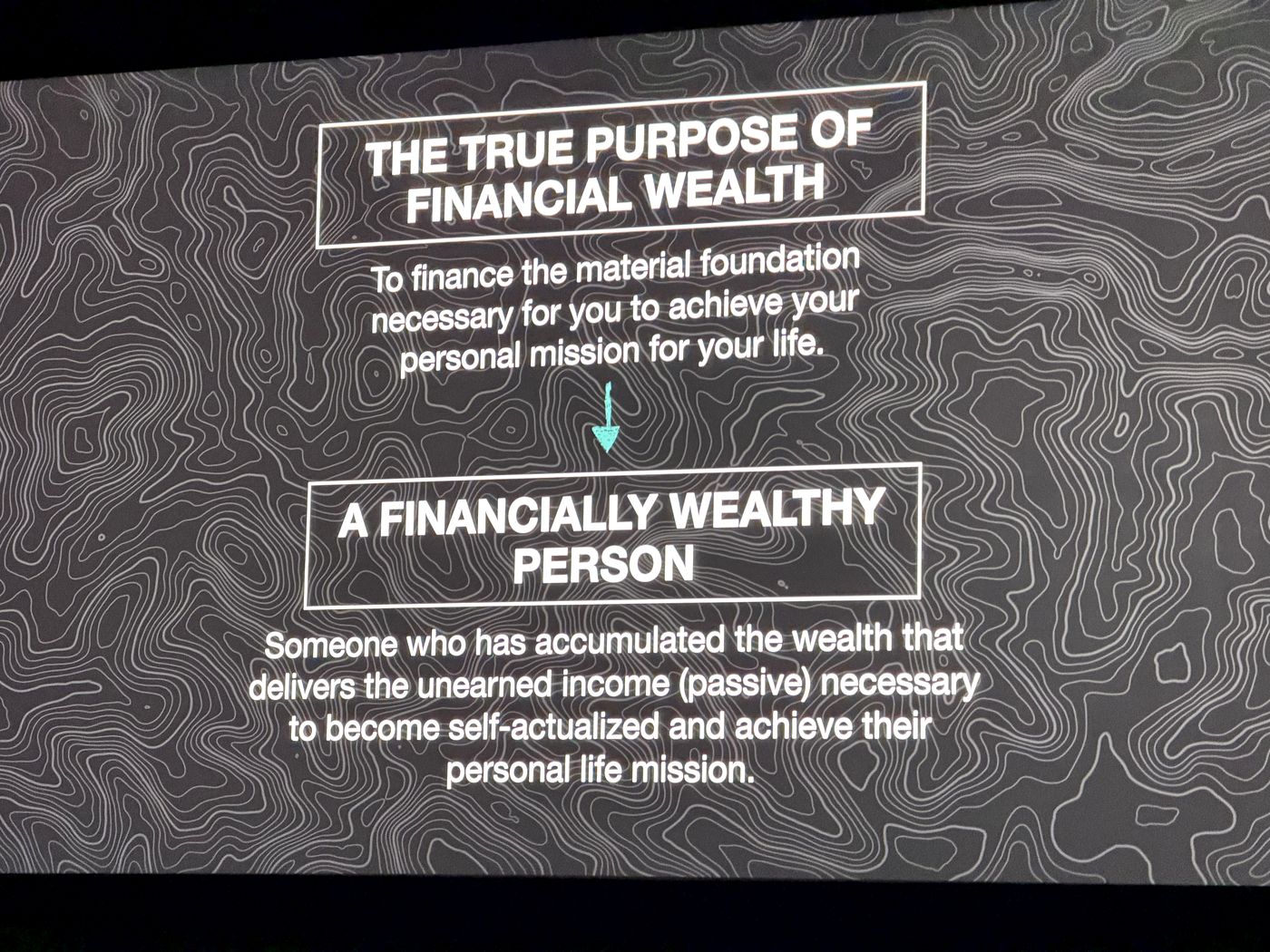
The true purpose of financial wealth is to finance the material foundation necessary for you to achieve your personal mission for your life.
From the slide
Which means the definition has a prerequisite. You have to know who you are and what you are for, otherwise you do not know what you are financing.
That’s why people set financial targets and have no idea what they’re related to. They just think that if they make that amount of money, life would be great. That’s not true, because if you don’t know why you need money, you’ll never have enough.
Gary Keller
The five truths about money

| # | Truth |
|---|---|
| 1 | The key to happiness is not more money. Happiness is happiness. Money is money. |
| 2 | Whatever your life is about, more money will amplify it. Money won’t change you, it will expose you. |
| 3 | Lifestyle is style over amount. You can’t buy style, good taste or good decisions with money. You can only buy more with more money. |
| 4 | The life quest is to have the best life in the time available to us. It’s not the amount, it’s the value. |
| 5 | Money will come to you when you are doing the right things. Money has its own rules and disciplines. If you don’t learn them, you are basically financially illiterate. |
His illustration of truth two was one line long and got the room.
Elvis had no taste. And when he got money, he proved it.
Gary Keller
On truth five he asked the kids he teaches whether their parents ever discussed money at the dinner table. No. Whether they took financial literacy in high school. No. In college. No.
Then how did you learn it? Oh wait. You didn’t.
Gary Keller
The part where it stopped being a finance talk
The fifth myth on his list is that wealth is about what you have. Visible wealth, the house and the cars and the watches, is very often bought by sacrificing the invisible kind. What the truly wealthy own instead is choice. Options, flexibility, security, the ability to say no, the ability to spend time where it matters, the ability to give.
Then he explained why he has always chased the highest income he could, and the room went quiet.
Four years ago his wife was diagnosed with Alzheimer’s. They are now in year five. He said she is doing amazingly well.
I had always tried to do my best and get paid the most amount of money I could. So when I looked up and realized what we were dealing with, I looked at the wealth we have and said, at least half of that is my wife’s, and I should split it off.
Gary Keller
He went to every clinic. He hired a full time scientist. He read the first five or six books on the subject and skimmed the next thirty or forty, until he had built what he calls a pyramid brain model, and then tested everything else against it. He offered to send it to anyone who asks.
She lives the brain life that I can afford financially. It’s not a question. I can afford it without even thinking about it, because I never thought about having enough money. I just tried to get as much as I could. And that shows up. That’s why I did it.
Gary Keller
He also said this year’s Mega Camp was organised so he could be back in Austin by five or six every evening. He said, plainly, that he lives in the service of his wife.
Luxury isn’t having whatever you want. It’s living however you choose. The richest person isn’t the one with the most possessions. It’s the one with the most freedom.
Gary Keller
Each one sounds reasonable, which is the problem
Myth one: wealth comes from making more money
Income is not wealth. Income is the fuel for wealth. Wealth is what you keep, invest and compound.
You’ve met people who make seventy five thousand a year who quietly become millionaires, and people who make a million a year who act like they’re broke.
Gary Keller
Myth two: wealth is built quickly
He is generous about hacks and says he lives by them, but not here. The first phase feels slow, the second one surprises you, the third changes your life. People overestimate one year and underestimate ten. My notes also caught a line worth keeping: diversification comes after you are rich, not before.
Myth three: investing is about picking winners
He was raised without money. A friend’s father retired at fifty and became an avatar for what was possible, so he paid attention. What he found was that he did not like investing, did not like thinking about money, and at first thought money was dirty.
It still is boring. What I discovered is that I made peace with the boredom until I got to the payoff.
Gary Keller
Time is usually a better investor than talent.
Gary Keller
Myth four: wealth is only about money
Money is one form of wealth. There is also health, relationships, spirituality, wisdom, freedom. Wealth means abundance.
If you accumulate millions but lose your marriage, or your health, or your integrity, or your peace, you may have become financially rich but you’re genuinely poor.
Gary Keller
Myth five: wealth is about what you have
Covered above. It is the one the Alzheimer’s story answers.
Four engines, and only four
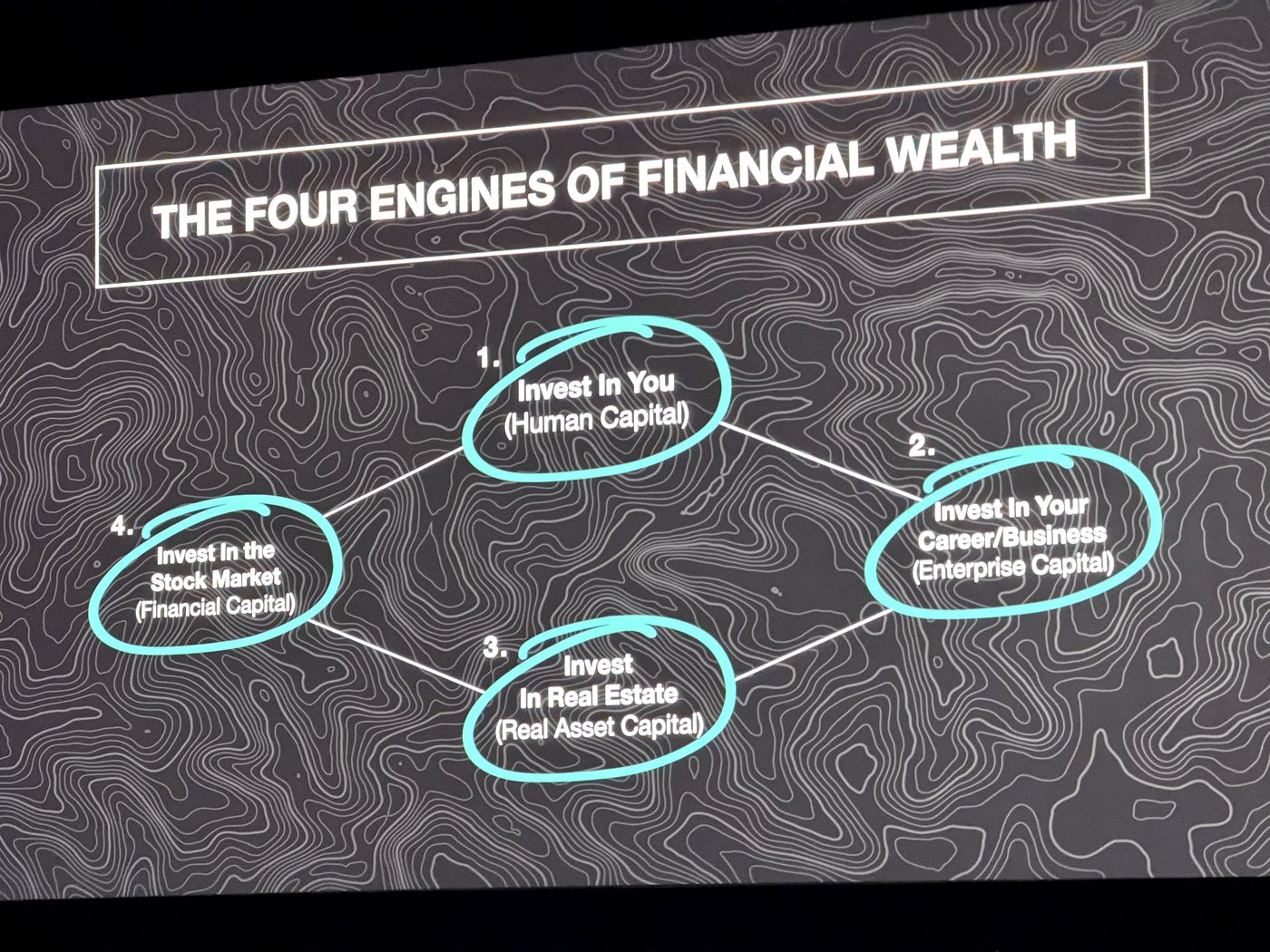
| Engine | Capital | What it produces |
|---|---|---|
| Invest in you | Human | Your ability to create value |
| Invest in your career or business | Enterprise | Careers create cash flow, businesses create ownership |
| Invest in real estate | Real asset | Leverage, appreciation, rent, tax treatment |
| Invest in the stock market | Financial | Ownership of productive businesses |
On investing in yourself, with a story
Thirty years of charity work has put Gary around his music heroes. He mentioned the Doobie Brothers and Carlos Santana. Driving one day with the lead guitarist of the Little River Band, he made the case that your job does not have to be your financial wealth, it is just the money you earn.
The guitarist said he had no money.
I said, let me ask you a question. Say I’ve got a million dollars right now, but you have to immediately tell me where we’re going to invest it to make money. Go. And he said, I don’t know.
Gary Keller
Your problem is not that you don’t have money. Your problem is you wouldn’t know what to do with it if you had it. If you knew what to do with it, you’d find the money, because capital is sitting everywhere waiting to make a good investment.
Gary Keller
On becoming irreplaceable, with another one
At twenty three he applied to manage an office and was told no. He asked for a test instead. If he passed it, they had to hire him. They wrote a list, he hit it in sixty days, and he asked to be sent where the growth was. They sent him somewhere remote enough that he called it Siberia, and he drove out every day to sell goat pastures.
Later the owner damaged the company badly enough that ten or twelve of Gary’s best agents walked out and took his administrator with them. They asked him to come. He said no, then went in and quit anyway, telling the owner he would fix the place first and leave after.
What was his response? How much can I pay you to keep you? In less than two and a half years we’ve gone from “no one likes you, I can’t hire you” to “how much can I pay you?”
Gary Keller
The path of money
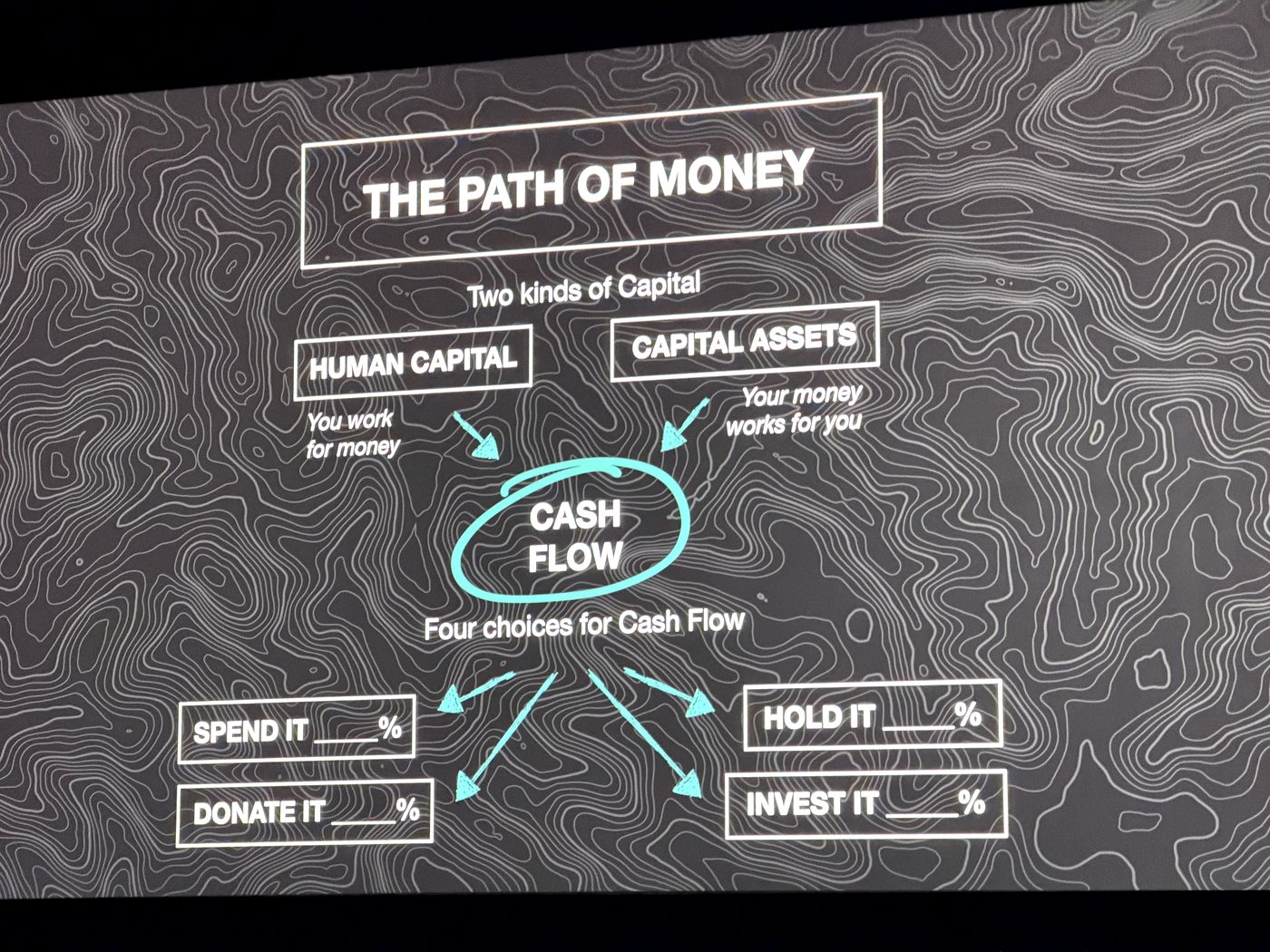
Two kinds of capital. Human capital, where you work for money, and capital assets, where your money works for you. Both produce cash flow. Cash flow gives you four choices: spend it, donate it, hold it, invest it.
The slide leaves the four percentages blank. He did not fill them in, but he gave the ratio he thinks separates people.
Someone who’s substantially wealthy has a dollar in their pocket and every day says, I have fifty cents to live on and fifty cents to invest. People who are not financially wealthy walk around and say, I’ve got a dollar to spend.
Gary Keller
His definition of a great investment
Repeatable actions done over time that deliver predictable outcomes.
Gary Keller, who added that the same definition describes a good business
The audio turned this into “investing is risky and taking risk is an investment,” which is nonsense. My notes have it right, and it is the opposite: investing isn’t risky, and taking risk isn’t investing. He attributes the thinking to Warren Buffett. The practical version he gave was that you have a model, and if the numbers work you invest, and if they don’t you keep looking.
The worksheet that changed how he saw it
A financial consultant friend traded monthly breakfasts with him, business advice for investing advice. The friend told him to fill out an asset and liability sheet, the kind a bank hands you, and update it every month.
We bought a car. I took the money off my assets and put the value of the car back on, and I’d lost money. I’d never seen it in print like that before. I just stared at it and went, well, I just lost money.
Gary Keller
He also credits Kiyosaki for the shortest version of the idea. Assets feed me, liabilities eat me.
Lend or own, passive or active
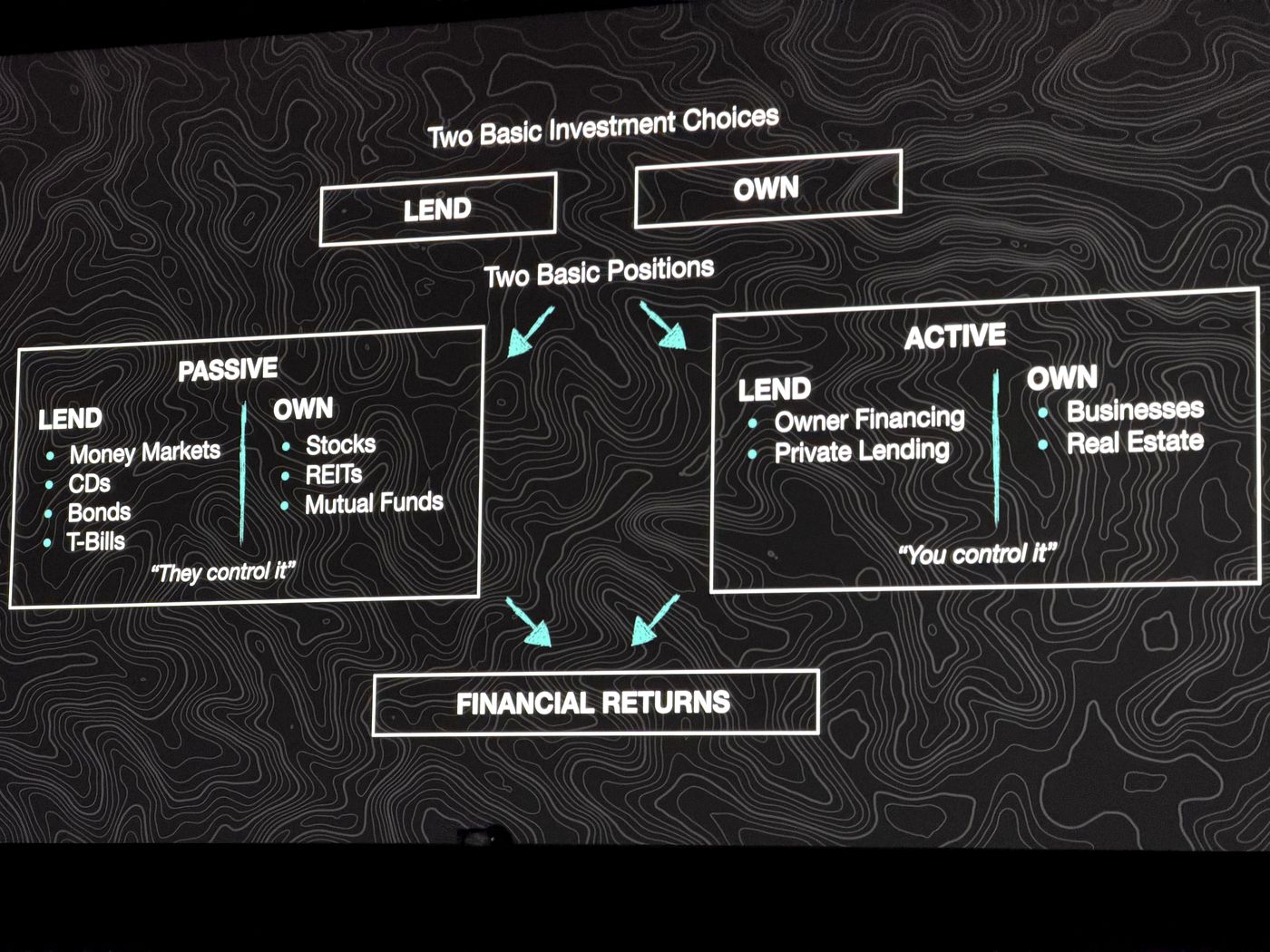
Once you decide to invest, there are two choices and two positions. You lend or you own. They control it or you do. That is the entire universe.
And this is where a room full of agents got the point of the whole session.
I’ve got a degree in an industry where if I’m selling clickers, that’s not a storehouse of wealth. But if I’m selling real estate, if my job is to wake up every day and understand value, holy cow, I’m getting paid to learn how to get rich if I pay attention.
Gary Keller
He estimates 70 to 80% of the real estate deals he has done in his life sit within ten or twenty miles of Austin. He has been there since 1979 and saw no reason to go further.
A hundred years, eight ways to own it
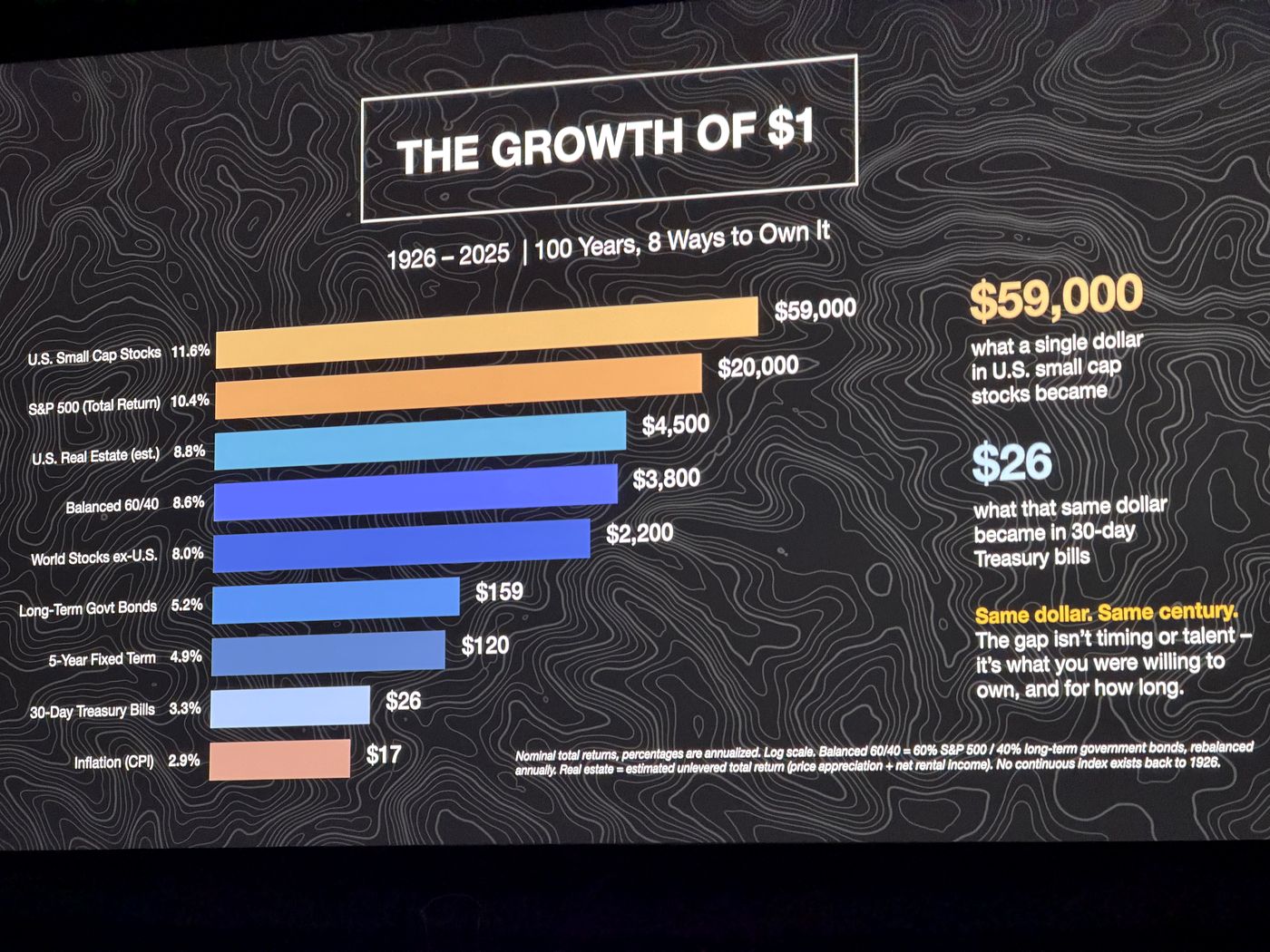
| Asset | Annualized | $1 became |
|---|---|---|
| U.S. small cap stocks | 11.6% | $59,000 |
| S&P 500 total return | 10.4% | $20,000 |
| U.S. real estate, estimated | 8.8% | $4,500 |
| Balanced 60/40 | 8.6% | $3,800 |
| World stocks ex-U.S. | 8.0% | $2,200 |
| Long-term govt bonds | 5.2% | $159 |
| 5-year fixed term | 4.9% | $120 |
| 30-day Treasury bills | 3.3% | $26 |
| Inflation | 2.9% | $17 |
The slide’s own caption: same dollar, same century, and the gap is not timing or talent, it is what you were willing to own and for how long. The footnote matters too. Those are nominal returns on a log scale, and the real estate figure is an estimated unlevered total return, because no continuous index goes back to 1926.
Then he did the thing that changes the chart
He flagged the unlevered caveat as he presented it, and came back to it later with a comparison over the same hundred years.
See that? See what just happened? Take that page and start handing it to people. This changes plans.
Gary Keller
The levered figure assumes you keep leverage at around 75%, which is the number in my notes. It is the difference between real estate as an asset class you passively hold and real estate as something you actively operate.
How long you hold changes everything
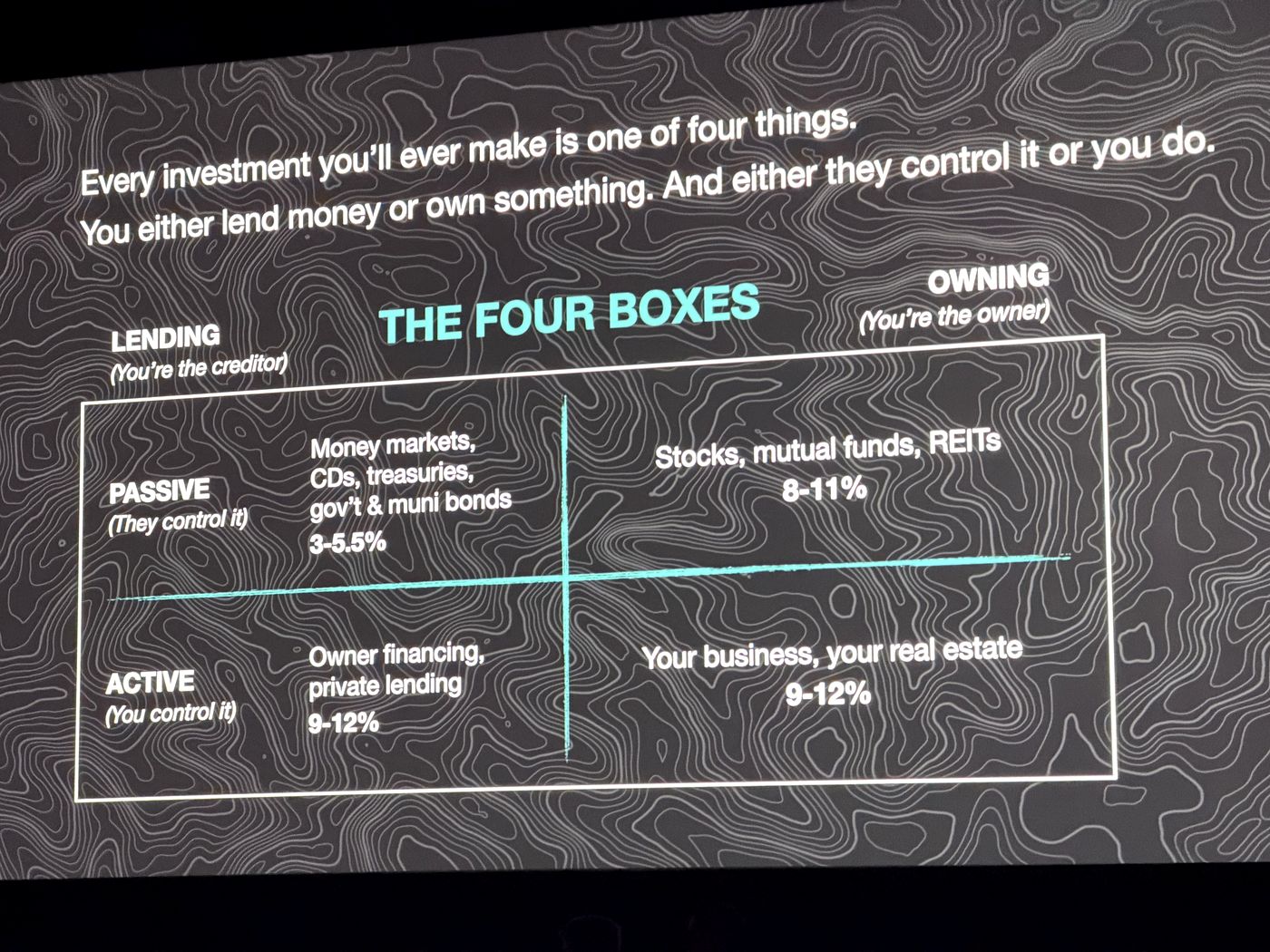
| Hold | Worst | Best | Verdict |
|---|---|---|---|
| 1 year | −43% | +54% | A coin flip |
| 10 years | −3.8% | +20.1% | Usually good, but 7% lost money |
| 20 years | +3.1% | +17.7% | Every single one made money |
Time doesn’t make the market go up. It makes the ups and downs cancel out.
From the slide
He anticipated the objection immediately. If you are fifty five, you are not out of it.
You have real estate, you have a business, you can still achieve all your goals. But the stock market is not going to do it.
Gary Keller
And then the version for anyone with kids. Start them in their twenties at a hundred dollars a month into an index fund and the arithmetic does the rest. He said he opened an account and put a hundred a month aside as each of his own kids was born, because he understood what it would become.
Three things the grid teaches
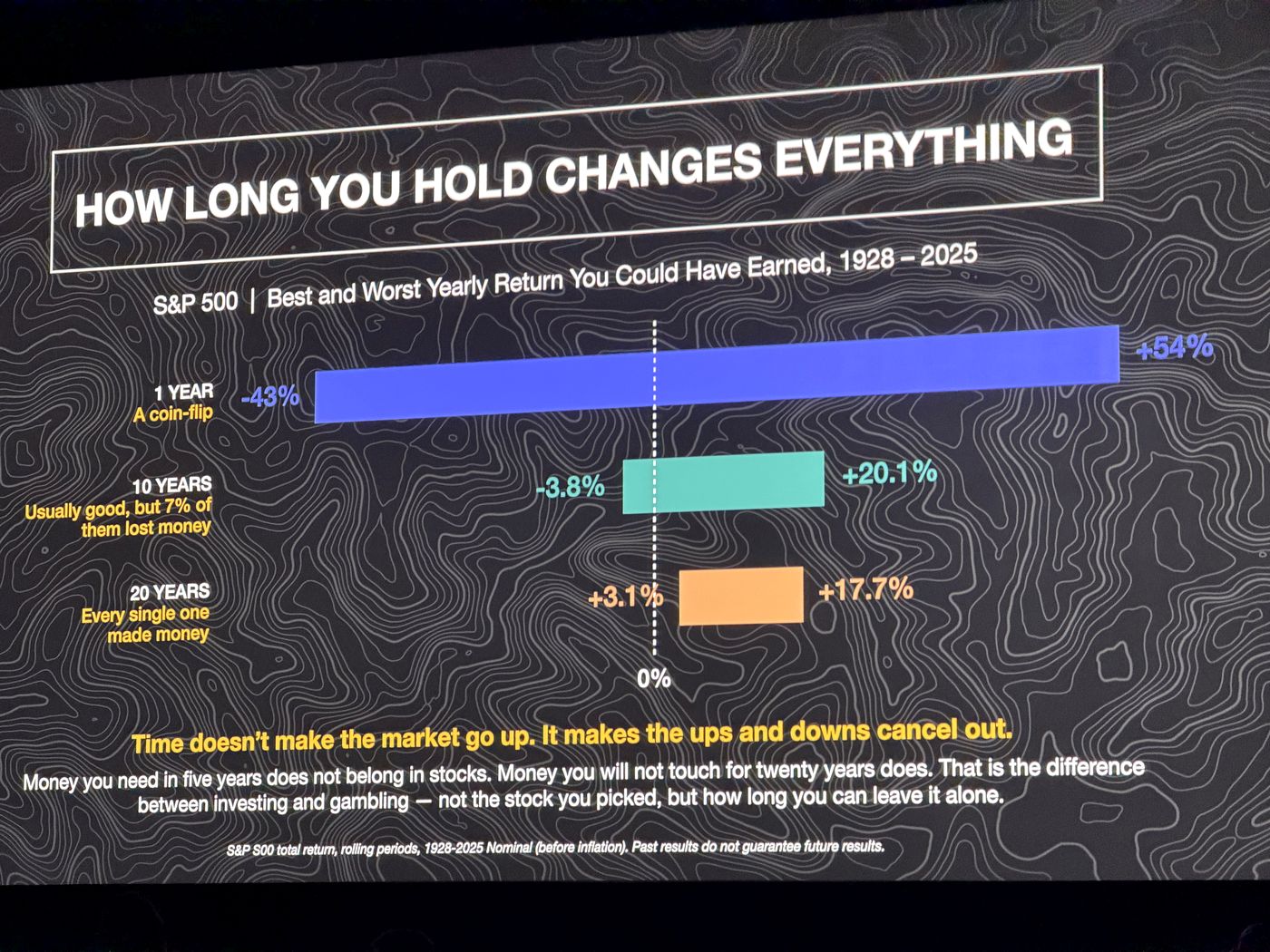
| Lending, you’re the creditor | Owning, you’re the owner | |
|---|---|---|
| Passive they control it | Money markets, CDs, treasuries, bonds 3 to 5.5% | Stocks, mutual funds, REITs 8 to 11% |
| Active you control it | Owner financing, private lending 9 to 12% | Your business, your real estate 9 to 12% |
One. Lending has a ceiling, owning does not. A contracted interest rate caps your best case. Lending gives you capped upside with real downside. Owning gives you uncapped upside with real downside. He does not recommend active lending for most people, on the grounds that plenty of borrowers do not pay you back.
Two. Control does not raise your return. This is the honest part and he did not soften it. He cited research on US private business ownership finding that returns to private businesses are no higher than public stocks, despite owners holding around 70% of their wealth in their own company.
That’s if you’re average. That’s if you’re no good at running your company. That’s if you buy the wrong real estate. If you intend to be average in your career and in running your business and in choosing real estate, I would just go to the stock market.
Gary Keller
Three. You do not get paid for control. You get paid for being good at it.
So why own actively at all
- You choose the property.
- You can change its value through improvement or by changing its use.
- Nobody will lend you 75% of purchase price on a thirty year fixed note to buy an index fund.
- No index fund gives you depreciation or a 1031 exchange.
- You cannot make your index fund worth more. You can make your business worth more.
The chiropractor
A friend Gary was born three doors down from lost his lease and needed somewhere to go. Told to buy instead, he said he had no money.
I said that’s not a problem. I’ll give you the money on these terms and we’ll own it fifty fifty, and at ten years, because you’re my dear friend, you buy me out at market value.
Gary Keller
At ten years the friend bought him out and Gary made a good return. Years later the friend told him it was the greatest investment he ever made. He put up no money. He put up the business.
Two ways to measure profit, and two price tags
This was the last stretch and he ran over to get it in.
| Measure | What it is | What the buyer is buying |
|---|---|---|
| SDE seller’s discretionary earnings | Profit with you in it, including your pay and perks | A job |
| EBITDA | Profit without you, with a manager’s salary already subtracted | An asset |
The ladder
| What you built | What it sells for |
|---|---|
| Owner dependent, weak records, inconsistent profit | 0 to 2× SDE |
| Owner operated, profitable, reasonably transferable | 2 to 3× SDE |
| Manager run, profitable, documented systems | 3 to 5× EBITDA |
| Strong manager, recurring revenue, growth projections, documented systems | 5 to 7× EBITDA or higher |
A buyer is paying for your profit that’s still there after you leave.
Gary Keller
Worked through with the room’s own numbers
He put average GCI in the room at around $250,000, then used a business earning $500,000 a year to make it concrete. Owner dependent, that is 0 to 2×, and the low end of that range is nothing at all.
Hire a general manager at $175,000 and the business now earns $325,000 without you. At 3× that is $975,000. At 7× it is roughly $2.3 million.
The sooner you get other people helping you run the business, and ultimately get someone to run it, you’re actually building wealth in that moment.
Gary Keller
If you were making two hundred thousand a year and you could live off a hundred, take a hundred, hire someone, and you immediately have a business.
Gary Keller
You are in the one industry where the job teaches the skill. Gary’s line about getting paid to learn how to get rich if you pay attention is the whole argument for why an agent has an advantage here that a salaried professional does not.
The levered versus unlevered page is the one to hand people. He said so himself. It is the difference between 8.8% and 11%, and it is the reason the century chart understates what you actually do.
Fill in the four blanks. Spend, donate, hold, invest. He left them empty on purpose. Fifty on fifty is his marker for what wealthy looks like.
Ask what your business is worth without you in it. If the honest answer is nothing, you have a job. The ladder from there is documented systems and somebody else running it.
And the uncomfortable one. If you intend to be average at your career, your business and your property choices, he told the room to skip all of it and buy an index fund. That is not a throwaway. It is the price of the active quadrant.
More from Mega Camp 2026
- Gary Keller’s market update, chart by chart
- Gary Keller on the four engines of wealthyou are here
- Gary Keller interviews Simon Sinek
- Amy Porterfield on social media feeding your database
- Corey Perlman on stopping the sell and starting to serve
Jason Flynn. I run a real estate office in Santa Cruz and write about AI, marketing and the operating side of the business. I go to a lot of these and write up the parts that were worth the trip.
Written from a recording that struggled in the room plus my own notes. Quotes are close paraphrase, not verbatim, and where the audio and my notes disagreed I have said so in the text. Gary opened by saying the entire framework is his own view rather than advice, and that framing holds for everything here. Figures are as presented on his slides, including his own caveats about what is estimated. Nothing in this is financial advice, from him or from me.
Like this? Get the next one.
The AI plays I'm running, a couple times a month. Free.