Gary Keller Interviews Simon Sinek
Mega Camp 2026 · Gary Keller interviews Simon Sinek
An hour of Gary Keller asking Simon Sinek questions. I expected a greatest hits run through Start With Why. It turned into a talk about friendship, and that was the most useful hour of the event.
All relationships are the same. The skills are transferable.
Simon Sinek, two minutes in
The way you build trust on a first date is the way you build trust with a client. If you are good at one and bad at the other, you already have the skill and are not applying it. Goals with no reason behind them leave you hollow even when you hit them. Courage comes from safety, and safety comes from one person having your back. And friendship, the relationship everyone neglects, is the one that improves all the others.
My recorder struggled and the auto transcript handed most of Gary’s questions to Simon. I rebuilt who said what against my own notes. Treat these as close paraphrase, not verbatim. Where Simon hedged his own numbers, I kept the hedge.
Ask more questions than you think you should
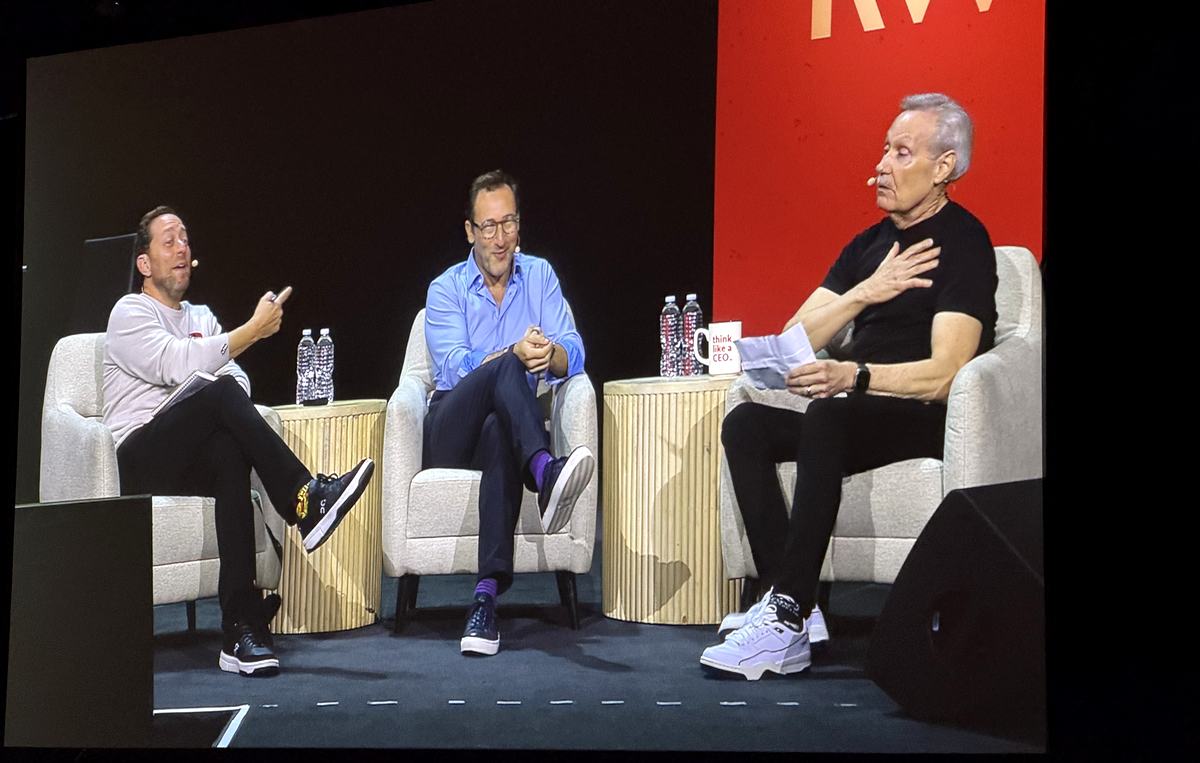
Gary opened by asking what Simon believes about people after a career studying them.
If you get really good at understanding people in a business context, you can transfer those lessons to your personal relationships. And the other way around.
Simon Sinek
A counselor tells you that you are a terrible listener. You fix it because you want the marriage to survive. Now you are a better listener with clients too. It does not stay in its lane.
He hedged that himself. He read it a long time ago, he is not sure the figures are exact, and what he stands behind is the ratio. Roughly five times more questions. The skill is asking, then asking a follow up based on what you actually just heard.
You can often tell when somebody works on commission. They just see me with a dollar sign on my head, like a Looney Tunes character.
Simon Sinek
Do not roll your eyes
He brought up Gottman, and the finding that you can predict whether a couple survives within about five minutes. The tell is one partner rolling their eyes while the other talks. Contempt. Once it is there, it is usually over.
If you find yourself internally rolling your eyes when you’re talking to clients or colleagues, you should probably get out of the business.
Simon Sinek
Jason Abrams said out loud that he had just written down “don’t roll eyes.” The room laughed. That is the session in miniature. A very simple thing most people would rather receive as a framework than go and do.
The athletes who get everything and crash
Gary asked why successful people get exactly what they wanted and find it is not what they wanted.
Because they are what driven, not why driven. And if the pursuit is only for you, you will have organised every relationship in your life around the goal. He named Michael Phelps and Andre Agassi reaching the top, and what followed both, which he said was depression.
If you’re serving me, I’ll keep you around. If you’re no longer serving me, I let you go. They don’t have deep friendships, because they sacrificed those for the goal.
Simon Sinek
He was sharp about the tidy answer those athletes give afterward, the one about inspiring children. Nowhere on the vision board was a kid. The vision board had the podium on it.
His counterexample was Curtis Martin, the Hall of Fame running back who did not much care about football. The first Super Bowl he watched was one he played in. He worked out that being good at a sport would give him a platform, and the better he played the more good he could do.
A why is always an act of service.
Simon Sinek
What money actually buys
Gary pushed back for the room. People think if they just succeed hard enough, money handles the rest.
Money buys options. It doesn’t buy happiness. But it pays for the yacht to pull alongside it.
Simon Sinek
Biggest laugh of the hour. Gary told everyone to write it down. His point underneath it was that we are finite oriented, focused on what is in front of us, and blind to the fact that good things compound slowly.
Discovery, not invention
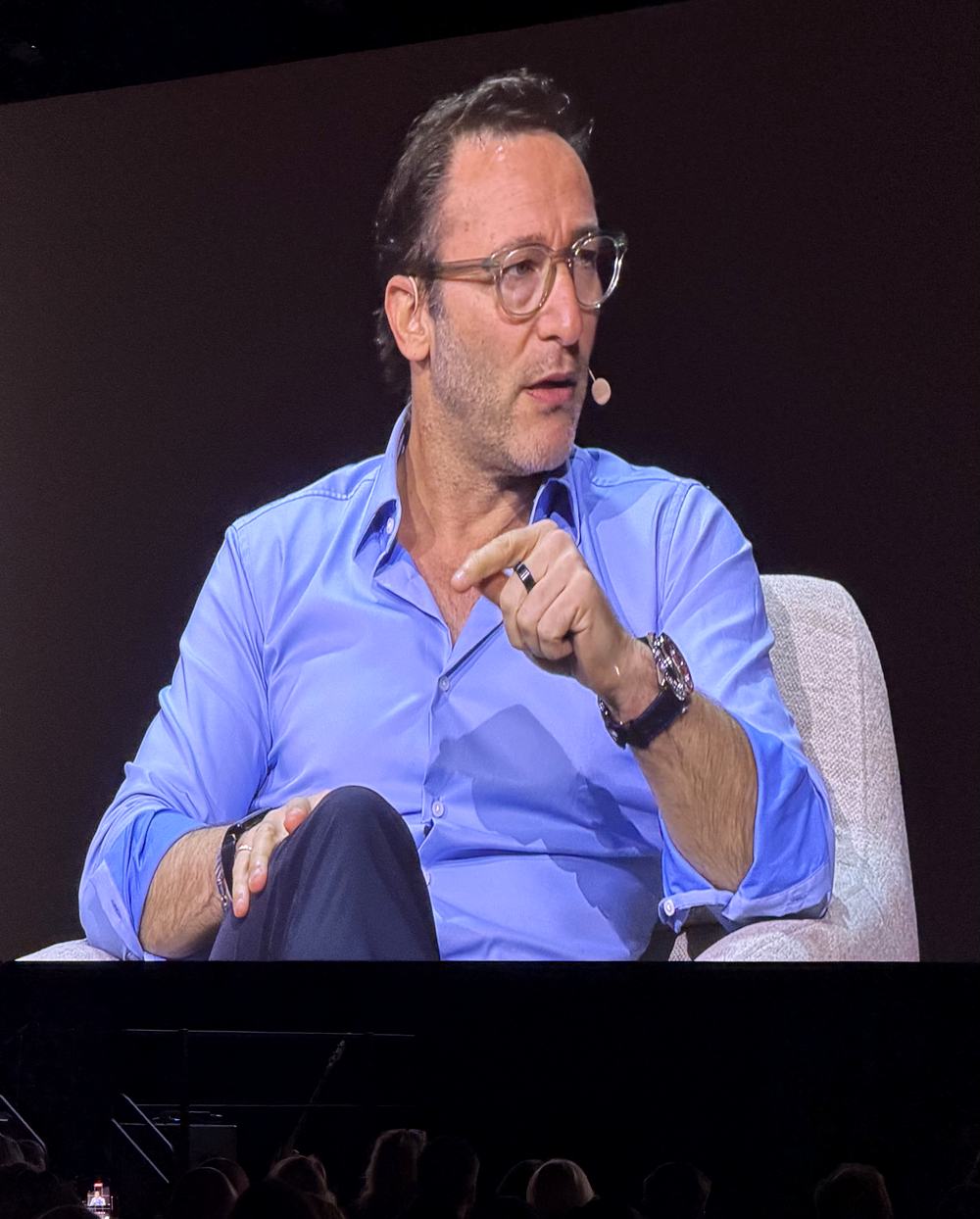
Your why is formed by your late teens and does not change. Everything after is decisions that either line up with who you are or do not. When you drift, your friends are the ones who say they do not know who you are anymore.
It’s a process of discovery, not invention. It’s more like panning for gold. It’s there. It’s about getting rid of all the stuff around it.
Simon Sinek
Why it is so hard to say out loud is anatomical, in his telling. The limbic brain drives decisions and has no language, which is why we fall back on “it just feels right.” The part that handles language does not make the call. So the data points one way and your gut refuses.
The Friends Exercise, which is free
Gary asked how you find yours. Simon named the workbook and the coaches, then gave away the version that costs nothing.
| Step | What to do |
|---|---|
| 1 | Pick a close friend. Not a spouse, not family. Those are too close to work. |
| 2 | Ask why you are friends. They will look at you like you are insane. |
| 3 | They will answer with what instead. Loyal, funny, trustworthy. Push back every time. Tell them you can get that anywhere. |
| 4 | Keep asking what specifically about you means they know you will be there. Do not help them. |
| 5 | Eventually they give up and start describing themselves. That is the moment. |
What Simon’s friend eventually said was that he could sit in a room with him without talking and feel inspired. Do it with a few people and you get the same answer, because they are all describing the same thing you give the world.
Gary answered his own question
Halfway through he stopped interviewing and talked about himself. He had always assumed he was a business person. Then it struck him that he is a teacher, and a writer, and that looking back he had been doing exactly that since his teens without deciding to.
That understanding has been the filter for everything in my life since.
Gary Keller
Simon lit up, because it made his point. Define yourself as a teacher and the benefit of your work goes to other people by definition.
You can always tell who walks out on stage to sell books or get followers. And you can tell when somebody shows up to give.
Simon Sinek
Then he told the better story
Gary had gone out to teach others what he was doing. As long as he was involved they succeeded. When he left they failed. So he came back to Austin, pulled two of his first partners and his first administrative hire into a conference room at a law firm, and asked one question. Why are you in business with me?
He wrote every answer on the glass wall, then made them look at it and told them a lot of these words mean the same thing, so pick one. The two that bookended the list were being a win win person and taking everyone with you. That became the belief system the company still teaches.
It is the Friends Exercise, run on a business, years before Simon named it. Gary noticed that himself and called it life changing.
Every bad sales call is a bad first date
Asked how you market a why rather than a what, Simon said story, because nobody enjoys being explained to. Then he did the bit from the book, which lands harder out loud. A guy called Dave sits down on a date and opens with this.
I’m extremely rich. I know a lot of famous people. I’ve got a great house, you should come by sometime. Yeah, I’ve done pretty well for myself.
Simon Sinek, as Dave
Everyone knows Dave is not getting a second date. Then he turned it around.
Our company is extremely successful. We’ve sold houses to some of the most famous people. We have a beautiful office, you should come and see it sometime. If we know instinctively that date was awful, why would we think that’s a good sales call?
Simon Sinek
Educated Dave says the same facts. He just leads with loving what he does, and the proof points arrive second.
His version for agents: answer “why should I choose you” with the story of your favourite client. A true one. Either they want to be that client to you, or they walk, which is also fine. A client who does not like you was never a lifelong relationship anyway.
Courage comes from safety

On what leadership gets wrong, his opening word was “most.” We heroize individuals, prioritise metrics over meaning, and promote high performers, which only proves they were good at the job. The learnable skills are unglamorous. Feedback, hard conversations, conflict, listening.
Then the strongest stretch of the hour. When they tried to identify what separates Navy SEALs from the rest of the military, the answer surprised everyone.
They love each other more than others have the capacity to. They fear letting down their teammates more than death.
Simon Sinek
Courage is not a personality trait. It comes from feeling safe, and feeling safe comes from knowing somebody has your back. The threshold is lower than you would guess.
All that’s required is one person who says, I got you. If this whole thing goes sideways, I’ll still be with you.
Simon Sinek
He tied it to companies running layoffs over a missed projection. Profitable, just not as profitable as promised, so you lose your job. Anxious people do not take risks, do not offer their best ideas, and do not look out for each other.
The thermometer, and his own correction
Gary asked the practical question. The Infinite Game sounds great, but I still have to make X contacts today.
Simon’s answer was university volunteers phoning for scholarship money. Numbers were down. Consultants rewrote the scripts, which helped a bit. Then somebody brought in an actual recipient to talk to the volunteers for five minutes. Same scripts afterward, and the numbers went through the roof. They were no longer calling for a thermometer on a wall. They were calling for a kid they had met.
He said “take all the thermometers down,” then corrected himself in front of the room, which I appreciated.
I was wrong about thermometers. It’s okay to measure progress. You’re just not doing it for the thermometer.
Simon Sinek
He is writing a book about friendship

Look at rising depression and anxiety, and throw longevity in as well. Friendship improves all of it.
If you want to be a better salesperson, you study sales. If you have problems in your relationship, you see a counselor. When you have problems in your friendship, there’s nothing. Why not?
Simon Sinek
And the ordering matters. Being a great leader does not make you a better friend. Being a better friend makes you a better leader.
We are bad at it because we take it for granted. Ask anyone in a marriage you admire and they say it was hard work and they did the work. Ask any great leader, same answer. Almost nobody says that about a friendship.
Would you cancel on a friend because you have a meeting? Would you cancel a meeting for a friend?
Simon Sinek
A friend makes one mistake and we quietly end it, where in a marriage a trust violation gets fought for. We have overvalued romance and undervalued friendship, when you can get through a life without getting married and you cannot get through one without friends.
Three things you can actually do
Gary’s list, taped to the desk
He admitted he was not naturally a good friend. His fix was mechanical. He wrote down the people he wanted to be close to, taped the list to the top of his desk at home, and works through it. Text, email, call. A habit rather than an intention.
Simon’s birthday calls
Your calendar already tells you. He calls close friends and sings, badly and on purpose. One friend told him at the end of the song that he was the first person to call all day. Not the first to sing. The first to call. Everyone else had texted.
The eight minutes
This is the one I will use. His friend Maria had been through something rough and had not asked for help, except she had, in texts that read like all her other texts. He could not tell the difference.
She had read that connecting for about eight minutes is enough to make somebody feel less alone. So they agreed on a code. If either needs it, they text and ask, do you have eight minutes. Anyone can leave a meeting for eight minutes. You are not solving anything. You are making the person feel like they are not on their own.
The value is not the eight minutes. It is knowing in advance that somebody will pull over. Same mechanic as the SEALs, and you can build it at work too.
On social media, which ties this to the rest of the event
Near the end came a question about social media, noting that around 90% of the room had said it does not come naturally and they only do it because they feel they have to.
If you don’t like it, everybody can tell. The people who are good at it do well because they enjoy it. The challenge is not to avoid doing it. The challenge is to do it in a way you want to do it.
Simon Sinek
He tried copying people with bigger followings, hated it, and it did not work anyway. The metrics he cares about are not followers. They are how many people trust the work and how many forward it, because forwarding it means spending your own credibility on it.
Which sits neatly next to what Amy Porterfield told the same room about social being a bridge rather than a destination.
Ned
Gary’s last question was what was on his mind that morning.
Simon paused long enough to apologise for it. Over the weekend a close friend had introduced him by video call to a man named Ned, who had ALS and could no longer speak. The next day another friend joined and they called Ned again, three old friends of twenty years, and Simon watching.
That morning he woke up to a text saying Ned had died.
I woke up with gratitude, and just how fleeting life is. Most of the stuff we stress about is really stupid. And I hate that it takes death or tragedy to remind us of that.
Simon Sinek
Asked why he came at all, given how much he turns down, he gave two reasons. The values, and that a room full of business owners is where he can do the most good. The world he imagines only happens if other people go and do the work.
Count your questions on the next appointment. Not to hit 34. To find out whether you are closer to 7.
Run the Friends Exercise once. It costs one awkward phone call and it is the same exercise that produced a company’s values on a conference room wall.
Answer “why should I hire you” with a story. The proof points still go in. They go in second.
Set up an eight minutes with one person. The point is not the call. It is knowing before you need it that somebody will pull over.
More from Mega Camp 2026
- Gary Keller’s market update, chart by chart
- Gary Keller on the four engines of wealth
- Gary Keller interviews Simon Sinekyou are here
- Amy Porterfield on social media feeding your database
- Corey Perlman on stopping the sell and starting to serve
Jason Flynn. I run a real estate office in Santa Cruz and write about AI, marketing and the operating side of the business. I go to a lot of these and write up the parts that were worth the trip.
Written from a recording that struggled in the room plus my own notes. The auto transcript misattributed several of Gary’s questions to Simon, so speaker attribution is my reconstruction. Quotes are close paraphrase. Where Simon flagged uncertainty about his own figures, I kept the flag. If you were there and I have something wrong, tell me.
Like this? Get the next one.
The AI plays I'm running, a couple times a month. Free.